
NVH Testing in Vehicle Validation: Methods & Uses
NVH Testing: Methods, Applications and Best Practices in Vehicle Validation
For OEM and Tier 1 engineering teams, NVH testing is far more than a comfort check. It is a validation discipline used to detect, quantify and solve unwanted noise, vibration and harshness before they turn into launch delays, customer complaints or expensive late-stage redesigns.
The discipline has long been essential across ICE, hybrid and electric programs, but electrification has made NVH even more critical. As combustion masking disappears, tonal content from inverters, gear meshes, bearings and auxiliary systems becomes far more noticeable. That is why the most relevant conversation today is not only what NVH testing is in general, but also how it is executed for modern electric powertrains. At EPowerLabs, this reality shapes both the testing methodology and the infrastructure behind every campaign.
This article explains the fundamentals of NVH testing from a vehicle-validation perspective while showing how EPowerLabs applies that knowledge to electric motors, inverters, e-axles and complete powertrains through its dedicated NVH testing services delivered at the electric powertrain testing labs in Spain.
What Is NVH Testing?
NVH stands for noise, vibration and harshness, a framework used to evaluate how a vehicle or component sounds, feels and responds under operating conditions. In engineering practice, NVH testing combines acoustic measurement, structural vibration measurement, and interpretation of the physical mechanisms behind each symptom.
Engineers distinguish between airborne and structure-borne noise, narrowband tonal behavior and broadband phenomena, as well as component-level anomalies and vehicle-level perception. The objective is not simply to record a noise event, but to determine when it appears, under which load and speed conditions it becomes relevant, and what physical source is driving it.
Controlled acoustic environments such as anechoic and hemi-anechoic rooms are fundamental to measurement quality. Standards such as ISO 3745 for precision acoustic measurements define rigorous methods for determining sound power and sound energy levels in these environments, supporting repeatability and reliable comparison across setups.
Why NVH Testing Is Critical for OEMs and Tier 1s
For manufacturers and suppliers, NVH performance is tightly linked to perceived quality. A system may be safe, durable and functionally correct, yet still feel commercially unacceptable if it sounds sharp, boomy, metallic or poorly controlled to the driver or passenger.
NVH testing also reduces engineering risk. When a tonal peak, resonance or transfer path is detected during development, countermeasures can still be applied in a structured way – through mount tuning, damping changes, micro-geometry adjustments, insulation strategy, calibration updates or stiffness optimization. Late detection almost always means slower and more expensive corrections.
From a validation perspective, NVH is therefore not a secondary discipline. It is a bridge between customer perception, engineering robustness, and launch readiness. At EPowerLabs, NVH work is approached as part of a broader validation logic that can also connect to performance testing, climatic and durability testing, and engineering services under one roof.
Why NVH Testing Is Especially Important in Electric Vehicles
Electric vehicles remove many of the masking noises that were traditionally present in combustion platforms. Without engine and exhaust noise, high-frequency tonal content from inverters, e-motors, bearings and gearsets becomes far more audible. That shift has raised the bar for refinement and made EV NVH one of the most sensitive areas of vehicle validation.
In practice, EV NVH also requires multi-domain correlation. Acoustic signatures must be analysed alongside electrical signals such as PWM switching frequency and phase current harmonics, as well as mechanical variables including speed, torque and torsional response. Diagnosing a tonal issue as mechanical, electromagnetic, or control-induced requires simultaneous, synchronised capture across all three domains. This is one reason why dedicated electric-powertrain specialists can accelerate root-cause identification compared with a more generic test approach.
The facility where EPowerLabs operates was built specifically around this reality. Every NVH bench at the facility includes synchronised electrical, mechanical and acoustic acquisition as a standard configuration — not an add-on.
Which Vehicles Require NVH Testing?
Almost every vehicle category requires NVH testing. Passenger cars and SUVs use it to refine comfort and perceived quality. Light commercial vehicles rely on it to limit fatigue over long duty cycles. Heavy-duty trucks, buses and off-highway platforms depend on it to manage structural loads, operator exposure and drivetrain behavior in demanding conditions. NVH is relevant wherever motion, rotating components, and customer perception intersect.
The discipline also applies across propulsion architectures. ICE vehicles must manage engine orders, intake and exhaust behavior, driveline activity, and road noise. Hybrid vehicles add mode transitions. Battery-electric vehicles intensify sensitivity to tonal and high-frequency phenomena, which is why they frequently require more detailed acoustic and vibratory characterization earlier in development.
Which Components Are Commonly Evaluated in NVH Testing?
A complete NVH program may include the powertrain, transmission, driveline, chassis, suspension, steering system, brakes, mounts, body structure, trim and interior interfaces. The scope depends on the symptom under investigation and the maturity of the program.
At vehicle level, engineers focus on what the customer finally perceives: cabin sound pressure, seat-rail vibration, steering-wheel vibration, floor vibration, transient responses during acceleration, deceleration and speed sweeps.
For electric programs, EPowerLabs brings that broader NVH discipline down to the components that matter most in electrified propulsion. We test electric motors, inverters, e-axles and complete powertrains, helping manufacturers understand both isolated component behavior and full-system acoustic performance before production.
How NVH Testing Is Performed
A robust NVH campaign starts with a clear hypothesis: what is the symptom, where does it appear, under which operating conditions does it become critical, and what level of correlation is needed between sound, vibration and system inputs. From there, the setup is defined around the asset under test, whether that means a single rotating component, a subassembly or a full vehicle system.
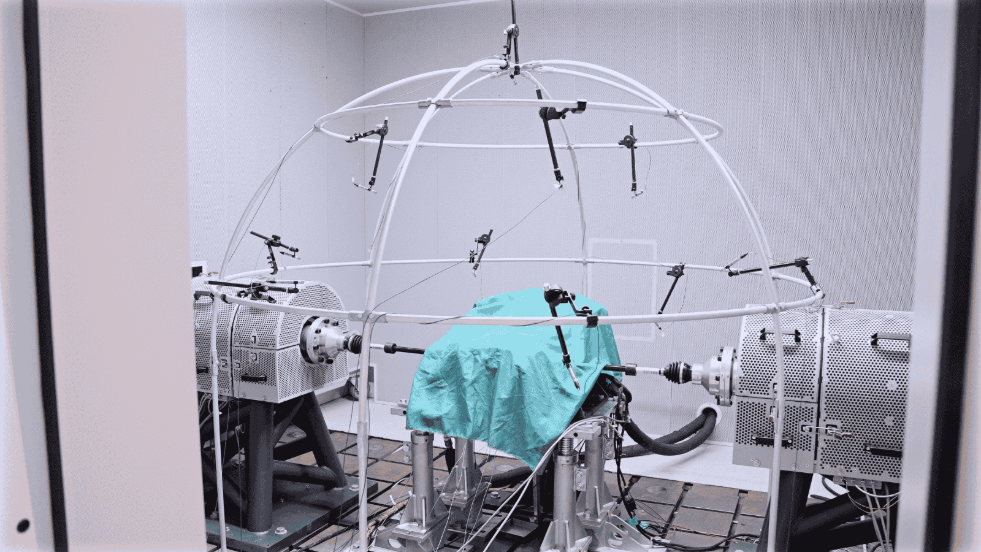
At EPowerLabs, all NVH campaigns are executed under controlled and replicable conditions in dedicated semi-anechoic chambers at MUBIL Center, the largest electric powertrain testing centre in Southern Europe. Three benches (EMT1, EMT2 and PWT1) are fully NVH-capable, covering high-speed e-motors up to 25,000 rpm, high-torque e-motors up to 2,200 Nm, and complete e-axle systems with dual 625 kW dynos.
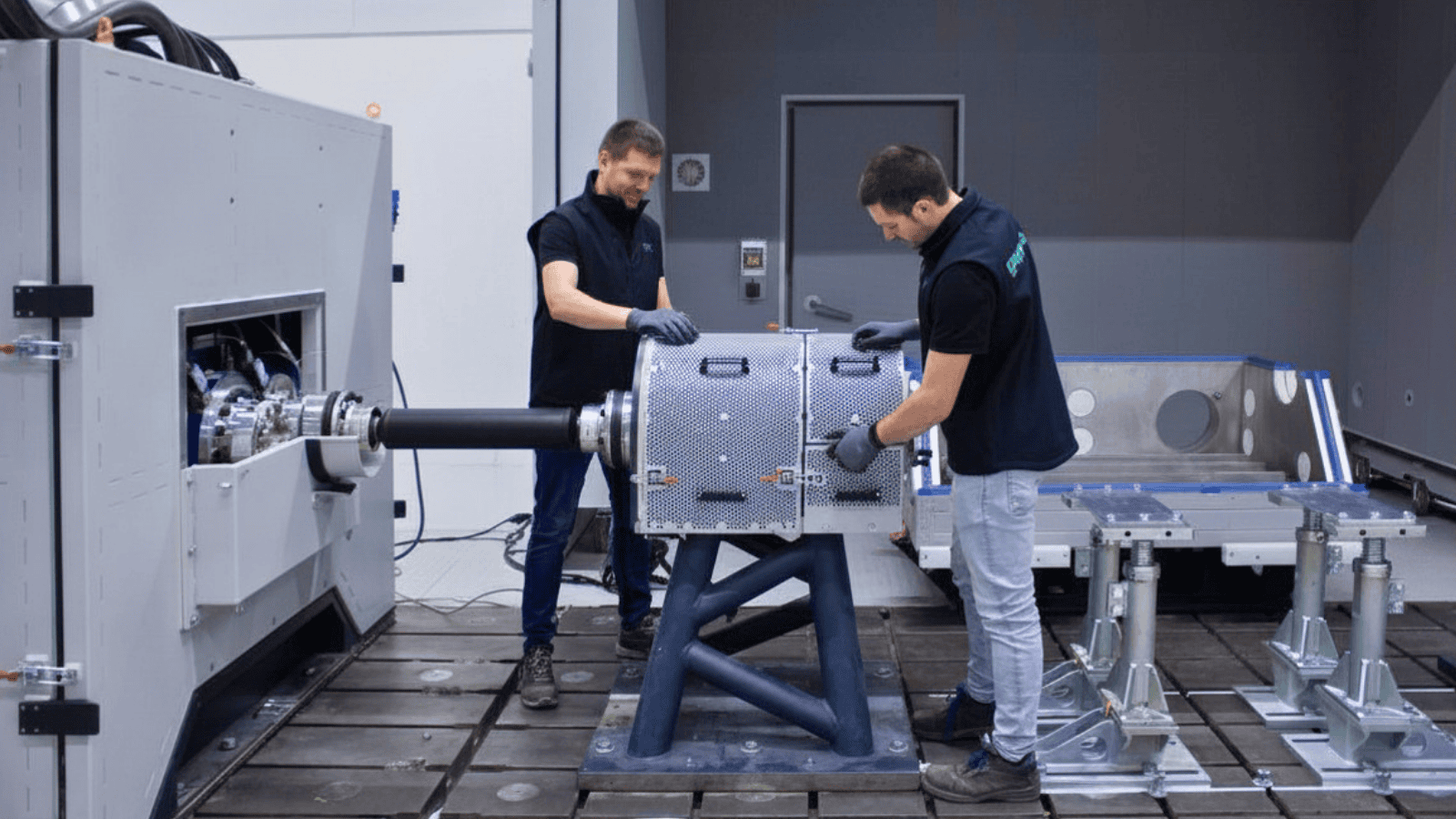
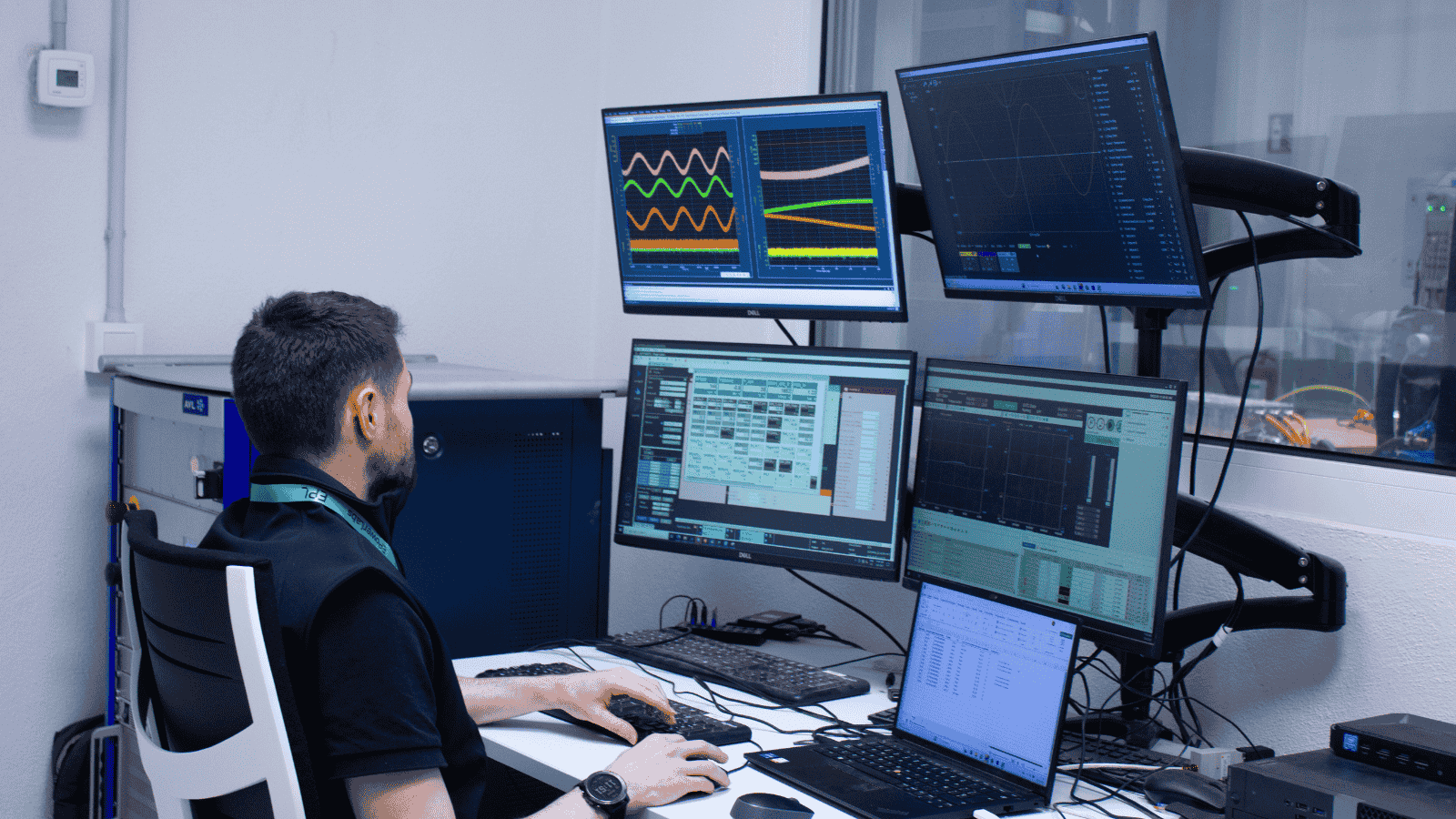
Each of these benches integrates an ISO 3745-compliant NVH chamber with precision tri-axial accelerometers and microphones as standard, capturing structure-borne and airborne noise simultaneously. Instrumentation is completed by HBK T12HP, HBK Genesis and AVL Xion multi-channel acquisition systems, and — critically for electric powertrain NVH — electrical signal acquisition for PWM switching, phase currents and inverter harmonics. All acoustic, mechanical and electrical channels are acquired synchronously in a single campaign, which is what makes root-cause attribution possible in electric drivetrains where the same symptom can originate from electromagnetic, mechanical or control-related sources.
EPowerLabs does not approach NVH testing as a generic measurement exercise. It is an engineering investigation built around the specific acoustic, vibratory, and electrical behaviours of electric propulsion systems. Full lab details and bench specifications are available on the NVH testing page and the testing labs page.
Main NVH Testing Methods and Analysis Techniques
Different test questions require different tools. Basic sound-pressure and vibration measurements provide the first picture, but root-cause analysis usually requires more. Frequency-domain analysis helps isolate peaks. Modal testing identifies structural response. Torsional analysis characterizes drivetrain fluctuation. Transfer-path analysis helps show how energy reaches the point where it becomes objectionable.
Order-related methods are especially important in rotating systems. HBK’s order analysis overview explains how order analysis connects speed-related sound and vibration patterns to rotating-machine behavior, which is directly relevant to gears, shafts, electric machine orders and bearing activity in vehicle validation.
EPowerLabs’ NVH testing service covers all these analytical needs: sound pressure, intensity and power measurement; vibration order analysis; random and sine vibration testing; modal testing (hammer and shaker); torsional vibration analysis; mount vibration and displacement; and dynamic NVH testing during launch and run-up. This breadth means the same team can move from symptom identification to root-cause analysis to design verification without changing partner.
Common NVH Issues Identified During Validation
Validation campaigns regularly uncover tonal peaks, resonance problems, booming, rattles, buzzes, harshness during transients, gear-mesh issues, imbalance-related vibration, mount tuning problems and unexpected structural transfer paths.
In electric programs, symptoms often become visible as inverter switching whine, electromagnetic excitation in the motor, gear harmonics in e-axles, torsional oscillation, bearing-related signatures, noise linked to auxiliary systems. What makes these particularly challenging is that the same frequency can have multiple possible origins (electrical, mechanical or control-related) and only synchronised multi-domain data makes the distinction possible.
A 2024 state-of-the-art review of vehicle NVH confirms how broad the source map is across EV, HEV and ICE platforms, spanning the powertrain, road-tyre interaction, suspension, brakes and wind-structure effects. EPowerLabs addresses that complexity directly: the entire testing setup is built to capture interactions across domains, not just isolated signals.
NVH Testing Across the Vehicle Development Cycle
NVH work should start early and continue throughout the full program. In concept and prototype phases, it helps compare architectures, benchmark competitors, and expose first-order risks. During design verification, it supports detailed tuning of components, controls and integration decisions. In pre-production, it confirms repeatability and readiness for sign-off.
The infrastructure managed by EPowerLabs at MUBIL Center supports this full lifecycle. The facility can handle short functional tests in early development as well as complete Design Validation Plan (DVP) execution for series programs, with parallel test campaigns available to accelerate timelines when programs are under schedule pressure.
This lifecycle view also explains why external specialists can add value. Internal teams do not always have the extra facility access, instrumentation bandwidth or niche EV-NVH expertise required at peak phases. Fast access to the right test environment can shorten decision loops significantly.
Challenges in NVH Testing
One of the main challenges is system complexity. Modern vehicles combine more functions, operating modes and subsystem interactions than before, creating a richer signal environment and a larger number of possible transfer paths. EPowerLabs addresses this by deploying synchronised multi-domain acquisition as standard, capturing the acoustic, mechanical and electrical signals in a single campaign rather than separate tests that must later be reconciled.
Another challenge is repeatability. Road conditions, ambient temperature, assembly variation, sensor positioning and control strategy can all alter results. The purpose-built ISO 3745 chambers and calibrated powertrain benches at MUBIL eliminate many of these variables by design, making it substantially easier to trust comparisons and quantify improvement objectively.
For electrified propulsion, the challenge grows further because the root cause may sit across electrical, mechanical, and acoustic domains simultaneously. EPowerLabs’ NVH reports are structured to rank findings by severity, customer perception impact and development risk, so teams can direct engineering effort where it will have the most effect on perception, durability, regulatory readiness and launch timing.
Best Practices for an Effective NVH Testing Program
The best NVH programs define target metrics early, align stakeholders on the symptom and test objective, and select instrumentation around a clear hypothesis. They combine laboratory and vehicle testing where necessary, include reference channels such as speed and torque, and maintain disciplined processes for data naming, setup control, and repeatability.
A strong report should move beyond plots and peak frequencies. It should explain likely source mechanisms, confidence level, recommended next actions, trade-offs between comfort, durability and performance.
EPowerLabs frames its NVH value proposition clearly: the goal is not only to detect and analyse unwanted noise and vibration, but to correct it before market entry. That mindset shapes how campaigns are designed, executed, and reported.
In practice, an EPowerLabs NVH campaign delivers against five key objectives:
- Detect and correct vibration and noise issues before market entry.
- Optimise component design for acoustic and structural performance.
- Support homologation readiness for the system.
- Validate NVH metrics according to OEM standards.
- Improve vehicle comfort and perceived product quality.
These objectives align directly with what development teams need at each stage of the program — whether the priority is risk identification in early development, design optimisation during verification, or sign-off evidence in pre-production.
Because EPowerLabs also offers performance testing, climatic and durability testing and engineering services under one roof, NVH findings can be directly connected to efficiency data, thermal behaviour or endurance results — reducing the coordination overhead that comes with multi-supplier validation programs.
Why NVH Testing Remains Essential for Robust Vehicle Validation
Vehicle programs may evolve, but the core value of NVH testing remains constant: it transforms subjective discomfort into measurable engineering data. That makes it one of the most practical bridges between customer perception and technical validation.
For OEM and Tier 1 teams, that means fewer late surprises, stronger evidence for design decisions, and a more robust path to launch. In a market where refinement increasingly shapes perceived quality — especially in electrified mobility — NVH is not a secondary discipline. It is a core part of vehicle validation.
FAQ
What does NVH mean in automotive engineering?
NVH means noise, vibration, and harshness. It is the discipline used to measure and improve how a vehicle or subsystem sounds, vibrates, and feels during operation.
Why is NVH testing more critical in electric vehicles?
Because EVs remove the masking noise created by combustion engines, tonal content from inverters, motor orders, gear mesh behaviour and bearings becomes far more audible. EV NVH also requires multi-domain correlation across acoustic, mechanical and electrical signals, making it more complex and more demanding than in conventional vehicles.
What types of vehicles undergo NVH testing?
Passenger cars, SUVs, commercial vehicles, buses, trucks, off-highway platforms, hybrids, battery-electric vehicles and internal combustion vehicles all use NVH testing when refinement and validation matter.
What components are commonly included in an NVH program?
Typical scope includes the powertrain, transmission, driveline, suspension, steering, brakes, mounts, body structure, trim interfaces and other components that can generate or transmit objectionable noise or vibration.
When should NVH testing begin?
Ideally, NVH testing starts in concept and prototype phases and continues through design verification and pre-production sign-off.
Need Support with an NVH Validation Program?
If your team is validating an electric motor, inverter, e-axle or full powertrain and needs repeatable, engineering-grade NVH testing, EPowerLabs is ready to support you. The purpose-built semi-anechoic chambers and calibrated powertrain benches at MUBIL, together with EPowerLab’s EV-focused expertise, are available from early characterisation through full DVP execution
Contact EPowerLabs to discuss your objectives, operating conditions, and timeline.


